May 20 2026 at 03:00PM
What PMXPO Gave Me Wasn't Just Inspiration — It Was a Framework to Do M.O.R.E
PMXPO end of March stood out from other conferences by focusing less on trendy methods and more on practical ways project and programme professionals can improve their approach to work. A key takeaway was the M.O.R.E framework, which left a lasting impact and is already being applied in real-world situations.
The Atmosphere: Familiar Faces, Fresher Thinking
PMXPO created a personal and engaging atmosphere where professionals openly discussed real challenges and shared honest experiences rather than polished presentations.
One panel in particular stood out. Seasoned PMO leaders openly discussed what isn't working anymore — rigid governance structures that slow down what they were designed to protect, success metrics that no longer reflect actual business value, and the quiet burnout that accumulates when you're doing everything technically right but nothing feels meaningfully impactful.
"On-time delivery doesn't automatically mean value delivered. We've confused the measure with the mission."
The M.O.R.E Framework — What It Is and Why It Lands
The M.O.R.E framework isn't a methodology. It's not a checklist or a certification. It's a mindset and operating model that reframes how project and programme professionals create value. Different speakers approached it from different angles, but the four pillars kept converging.
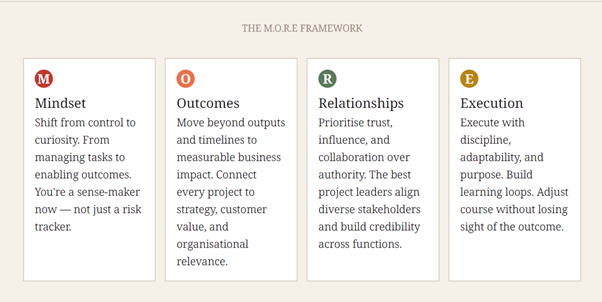
M — Mindset: The hardest shift and the most important one
Several speakers made the same point from different angles: the project professionals who are thriving right now aren't the ones with the most sophisticated planning tools. They're the ones who arrive curious, not controlling.
The old mental model — predict everything, track everything, report everything — worked when the world was slower. Today it creates a false sense of control while the actual problem evolves around you.
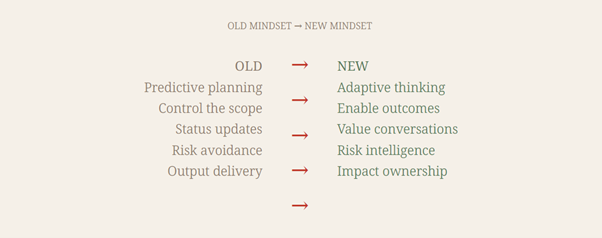
O — Outcomes: What success actually looks like
This was perhaps the most universally felt pain point in the room. We've been trained to celebrate on-time, on-budget delivery. Those metrics made sense once. They still matter. But they can mask a deeper failure — delivering something no one actually needed, or solving yesterday's problem with tremendous efficiency.
Outcome-focused professionals anchor their planning differently. They start with 2–3 clear outcomes and map activities to them, rather than building task lists and hoping they somehow add up to something meaningful.
R — Relationships: The underrated competitive advantage
This came up repeatedly, and I'll be honest — it's the area most technical project professionals underinvest in. The most successful programme leaders at PMXPO weren't necessarily the best planners. They were the ones who could walk into a room of hostile stakeholders and leave with alignment.
Trust is built in small moments — not in project kickoffs. A 15-minute check-in with a stakeholder that has nothing to do with your RAG status does more for delivery than three steering committee decks.
The relationship question I have started asking myself before every stakeholder interaction: "Am I here to report, or am I here to understand?" If the honest answer is only the former, I reschedule.
E — Execution: Discipline with a learning loop
Execution still matters enormously. Let's be clear about that. The pendulum hasn't swung so far toward "agile mindset" that delivery rigour is optional. What's changed is the kind of execution that wins.
Blind execution — heads-down, on-plan, no questions — is how you deliver something perfectly wrong. The execution model PMXPO advocated for builds in reflection points: What did we learn this sprint? What has changed in the environment? What should we adapt without abandoning the outcome?
The Four Takeaways That Hit Hardest
- Relevance is now a skill, not a given Certifications and experience matter. But in a world where AI can draft your project plan, your value is in the judgment calls, the context, the relationships. That requires continuous learning— not as a virtue but as a survival instinct.
- Value conversations beat status updates Senior leaders care less about what percentage complete you are and more about whether you're still solving the right problem. Start your next steering committee update with the outcome, not the timeline.
- Soft skills are hard differentiators Communication, empathy, influence — these consistently separated good project managers from great ones at PMXPO. Not as personality traits. As practised, learnable, deployable skills.
- Community accelerates growth — faster than content The conversations between sessions taught me as much as the sessions themselves. Shared experience sharpens insight in a way that no course, blog, or certification can replicate. PMXPO reminded me not to underestimate that.
What M.O.R.E Looks Like on Monday Morning
Frameworks only matter if they change behaviour. Here's what's actually different in how I work now.
Before I open a project plan, I ask two questions: What problem are we truly trying to solve? And what assumptions are we making about it? This has changed the quality of early conversations from "when can you deliver?" to "what does success actually look like?"
I anchor planning around outcomes, not tasks. Two or three clear outcomes sit at the top of every plan. Activities map to them. If an activity doesn't map to an outcome, it either needs a very good reason to exist, or it gets cut.
I have started stakeholder conversations that have nothing to do with status. Just: what's keeping you up at night? What's shifted in your priorities? These short conversations have reduced friction in delivery more than any governance mechanism I've tried.
I build reflection into execution. Not as a retrospective at the end — as a brief, honest check-in during delivery. What's changed? What did we learn? What should we do differently? This has improved team engagement and, critically, reduced the late-stage surprises that kill delivery confidence.
PMXPO didn't just give me ideas — it gave me clarity. Clarity about where this profession is headed, and what it takes to stay relevant, grounded, and genuinely impactful in it.
Follow our News